Ayodhya
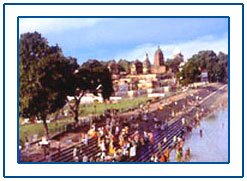 City
of Lord Rama City
of Lord Rama
The city of Ayodhya is an important pilgrim place for Hindus
in India. It is one of the seven holiest cities of India.
Ayodhya is the birthplace of Lord Ram, who is an important
deity in the Hindu pantheon. This small, quiet town attracts
pilgrims from all over the country. Hindu pilgrims visiting
Ayodhya during festivals and important religious functions
consider a holy dip in the sacred Saryu River very auspicious.
Ayodhya is located in center
of the state of Uttar Pradesh, in the northern region of India.
It is a part of the great northern plains and is situated
on the south bank of river Saryu. The climate of Ayodhya is
tropical. The summers are hot (April-June) while the winters
are cool (November-February). The southwestern monsoon rains
hit Ayodhya in July-September. Ayodhya is 130 km east of Lucknow
and 6 km from Faizabad.
Places
to See
The main tourist attraction
of Ayodhya was the Babri Masjid (Mosque),
built by the Mughal king Babur. Unfortunately, the traveler
can no longer see this monument as it was demolished in the
riots that took place here in 1992. It is said that Ayodhya
has 7000 temples, but there are some 100 temples of relative
significance. Near the remains of the Babri Masjid, the traveler
can see the Ram Janmabhumi (birthplace of
Lord Ram) shrine. It is believed that Lord Ram spent much
of his childhood here. Other places to visit in Ayodhya are
Lakshman Ghat, Kala Ram temple and the Kanak
Bhavan temple, which was built in the 19th century. There
are several Jain shrines in Ayodhya. One kilometer east of
the Ram Janmabhumi shrine is Hanumangadhi
(Fortress of Hanuman, the revered monkey god and friend/devotee
of Lord Ram). It is said that Lord Hanuman lived in a cave
nearby to protect the Ram Janmabhumi.

|