Ajmer
Sharif
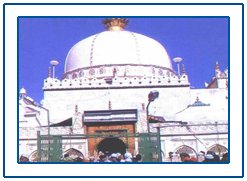 Ajmer
is famous for the tomb of Hazrat Mu'inuddin Chishti,
the founder of the Chishti Sufi order, one
of the most important Sufi organizations in India and Pakistan.
Sufi teachers were important missionaries of Islam, through
their piety, charisma, blessings, and service. Muinuddin lived
in Ajmer from 1190 until his death. Ajmer
is famous for the tomb of Hazrat Mu'inuddin Chishti,
the founder of the Chishti Sufi order, one
of the most important Sufi organizations in India and Pakistan.
Sufi teachers were important missionaries of Islam, through
their piety, charisma, blessings, and service. Muinuddin lived
in Ajmer from 1190 until his death.
People of all religions
visit the Dargah of Khwaja Moinuddin Chishti.
The Khwaja left for heavenly abode after a six day prayer
in seclusion. These six days are celebrated every year as
the annual Urs, which is attended by innumerable pilgrims
irrespective of their faith.
The shrine is considered
to be a place of wish fulfillment for those who pray with
devout and pure hearts. It is said that Emperor Akbar sought
blessings for his son at the Dargah.
The entry to the Dargah
is through the Dargah Bazar that leads to the inner courtyard.
The high gateway has beautifully carved silver doors. In the
courtyard are kept two huge cauldrons with capacity of 2240
kg and 4480 kg. On special occasions, 'Kheer' cooked in these
cauldrons is distributed among the pilgrims. The grave of
the Sufi Saint is surrounded by a silver railing and is partially
covered with a marble screen. The daughter of Shah Jahan had
built a prayer room in the Dargah for the women devotees.
The premises of the Dargah also has the tomb of Bhishti, tomb
of Saint's daughter-Bibi Hafiz Jama, tomb of Shah Jahan's
daughter Chimni Begum.

|